Why the PG security deposit causes most move-out fights
Ask a PG owner what residents argue about most, and the answer is rarely the rent. It is the PG security deposit, on the last day, when the resident wants ₹15,000 back and the owner has reasons why it should be less. The resident remembers a different amount, nobody wrote down what could be deducted, and the refund "will come next week" without a date.
Almost every one of these arguments could have been settled on the day the resident moved in. The trouble usually comes from four gaps:
- The amount was never written down against the resident's name, or it was paid in two parts and only one was noted.
- The rules were spoken, not written: the notice period, what counts as damage, when the refund comes.
- Deductions arrive as one number ("₹4,000 cut") instead of a list the resident can check.
- The refund has no date, so every day of waiting feels like the money is being held back.
Close those gaps and the deposit becomes what it should be: a quiet safety net that nobody talks about until the last day, and even then only briefly.
How much to take, and the rules to set at move-in
There is no single right amount. Many PGs ask for one or two months' rent; some take a flat amount per room type. What matters more than the number is that it is the same rule for everyone in the same room type. When two residents in one 3-sharing room have paid different deposits, they will find out, and the conversation that follows is never only about money.
Whatever you choose, put your terms in writing at move-in — on the form the resident fills in, on a printed sheet in the room, or in the message you send when they confirm. Keep it short enough that people actually read it. Your hostel deposit rules should answer six questions:
- How much is the deposit, and is any part of it non-refundable, such as a one-time maintenance fee? If so, say so in rupees.
- How much notice must a resident give before leaving, and what happens if they leave without it?
- What can be deducted: unpaid rent, unpaid charges such as a share of the room's electricity bill, and damage beyond normal wear and tear.
- When the refund is paid: on the last day, or within a set number of days after the room is checked.
- How it is paid: back to the resident's UPI or bank account, not as cash handed over by whoever is at the desk.
- Whether the deposit can be used as the last month's rent. Many owners say no, because it leaves nothing to cover damage.
Ask the resident to confirm they have read it. A one-line "OK, understood" on the day they move in saves a long argument on the day they leave.
Collect the deposit with a receipt, every time
The deposit is usually the largest single amount a resident pays you, so treat it like one. Collect it before or on the day of move-in, give a receipt for it separately from the first month's rent, and record it against the resident's name and bed.
If a resident pays in parts, record each part as it comes in, and keep the balance visible to both of you until it is cleared. "₹10,000 now and ₹5,000 on salary day" is fine, as long as the ₹5,000 does not quietly become nobody's job to collect. The same habits that get rent collected on time — a bill, a due date, a receipt — work for deposits too.
Keep a running total of deposits held across the PG. That is money you will have to pay back. Spending it as if it were rent is how owners end up struggling when three residents leave in the same month.
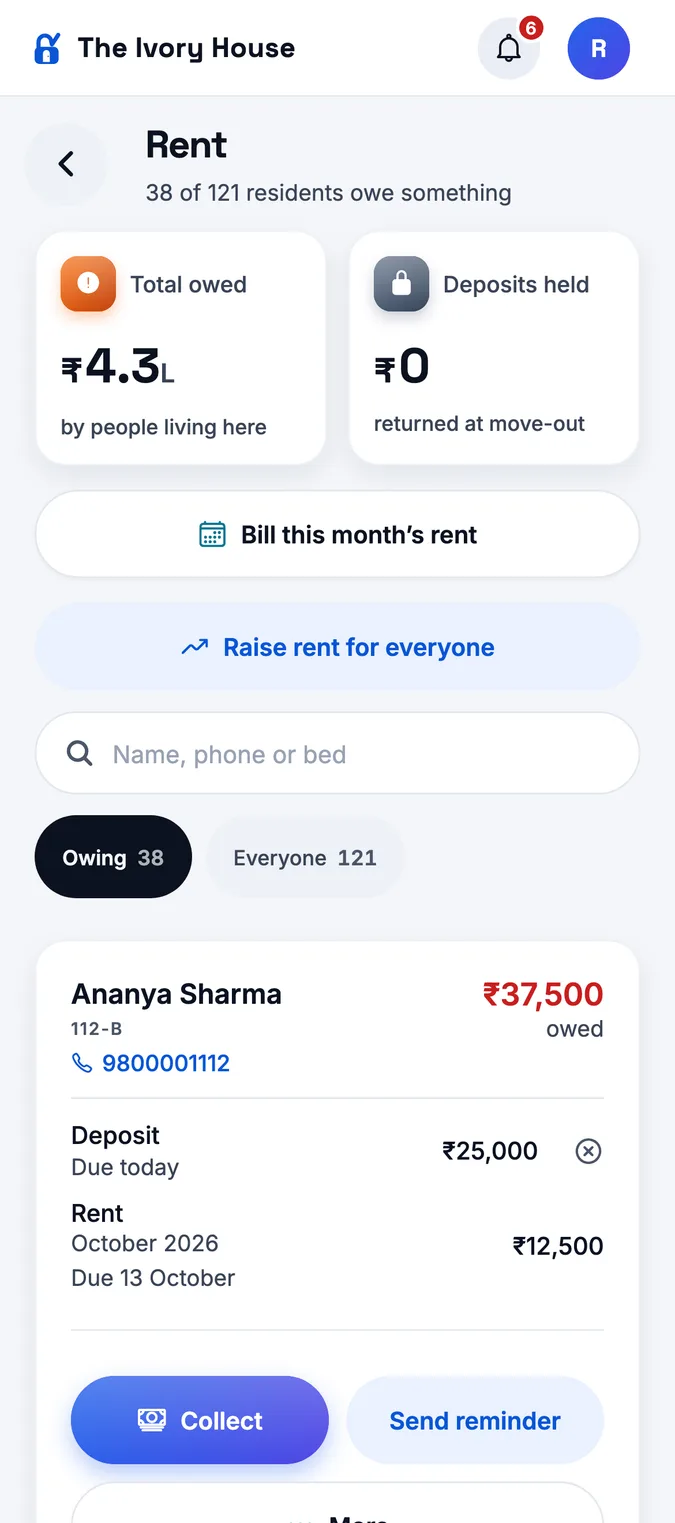
- The deposit is billed at move-in alongside the first month's rent, and the resident sees it on their own Pay screen.
- When it is paid, in one go or in parts, it gets a receipt like every other payment — by UPI to your own account, or in cash at the desk.
- The Rent screen shows the total deposits held, so you always know how much you will owe back at move-out.
Moving an existing PG into an app? Deposits you already hold can be brought across with each resident, so nobody is asked to pay them twice. Our guide to moving your PG records from Excel shows how.
Agree the notice period on day one
Many deposit disputes are really notice disputes. A resident who gives two days' notice and expects a full refund, and an owner who keeps the whole deposit for it, are both acting on rules that were never agreed.
Pick a notice period that suits your PG — fifteen days and one month are both common — and write down what happens if someone leaves without serving it. The usual approaches are to charge rent for the days of notice not served, or to keep a fixed part of the deposit. Either is fair if it was agreed at the start. Deciding on the day is not.
When a resident gives notice, note the date and their last day, and confirm both back to them in writing. That message is your record when the settlement comes round.
Notice is also your chance to fill the bed. A resident leaving on the 30th is a bed you can start showing on the 15th. If you keep a rooms and beds board, mark that bed as on notice so whoever shows rooms knows it is coming free.
The move-out settlement: itemise every deduction
On the last day, walk through the room with the resident before they hand back the key. Check the bed, cupboard, lock, fan, lights, bathroom fittings and anything else you provided. If something is damaged, show it to them there and agree a figure, rather than sending a number by message a week later.
Then write the settlement as a list, not a single figure. Every rupee taken from the deposit needs a line and a reason. Here is an example for a resident paying ₹8,500 a month with a ₹17,000 deposit, leaving on 12 November without having paid November's rent:
| Item | Amount |
|---|---|
| Deposit held | ₹17,000 |
| Rent, 1–12 November (12 of 30 days) | − ₹3,400 |
| Share of the room's electricity bill | − ₹650 |
| Broken cupboard lock, replaced | − ₹400 |
| Refund due | ₹12,550 |
Two things make a settlement like this hard to argue with. Every deduction is something the move-in terms said could be deducted, and every one has an amount the resident can check. Normal wear and tear — a faded wall, a mattress that has been slept on for a year — is the cost of running a PG, not a deduction.
If the deductions add up to more than the deposit, the difference is money the resident still owes you. Raise it before they leave, while you can still talk to them in person.
Moving a resident out works out a settlement for you: their unpaid rent and charges, and any deductions you add, are set against the deposit, and the rest is shown as the refund due. Charges raised during the stay — a split electricity bill or a repair charged to the room — are already in their dues, so nothing is forgotten on the last day.
Refund on time, and keep the record
The PG deposit refund is the last thing a resident remembers about your PG, and it is what they tell friends who ask about it. A refund that arrives on the promised day, with a clear list of deductions, does more for your name than any advertisement.
- Pay on the day you promised. If the room check is on the last day, many owners refund the same evening. If you need a few days, give a date, not "soon".
- Pay to an account, not in cash. A UPI or bank transfer leaves its own record. Note the transaction reference against the refund.
- Send the settlement with the refund. The resident should see what was held, what was deducted and why, and what was paid back, in one message.
- Keep the records after they leave: the move-in terms, the deposit receipt, the settlement and the refund. If a question comes up months later, the answer is in the file, not in anyone's memory.
- Record the refund when you pay it — on the last day or later — and the deposits held total drops by exactly that amount.
- Made a mistake? Owners and managers can undo a move-out or a deposit refund at any time. Receipts are reversed, never deleted, so the history stays honest.
A deposit checklist, from move-in to refund
Whether you keep a notebook, a spreadsheet or use StayOne, these are the steps that keep deposits out of arguments:
| When | What to do |
|---|---|
| Before move-in | Share the deposit amount, notice period, what can be deducted and the refund timeline, in writing. |
| Move-in day | Collect the deposit, give a receipt and record it against the resident and bed. Take a few photos of the room as it is. |
| During the stay | Keep part-paid deposits visible until cleared. Do not spend deposits held as if they were rent. |
| Notice given | Note the date and the last day, and confirm both to the resident in writing. |
| Last day | Check the room together and agree any damage on the spot. |
| Settlement | List every deduction with an amount. Show the refund due, or the balance still owed. |
| Refund | Pay to the resident's account on the promised day and record it with the transaction reference. |
Get the first two rows right, and the last three take ten minutes.