Why PG complaint management decides who stays
A PG can get the rent, the food and the location right and still lose residents every month. The reason is usually not one big problem. It is a geyser that has been "being looked at" for nine days, a WiFi router nobody restarts, a leaking flush the warden said he would tell the plumber about. Good PG complaint management is less about fixing everything at once and more about making sure nothing reported is forgotten.
Residents are surprisingly patient about problems. What they are not patient about is silence. A resident who hears "plumber is coming tomorrow at 11" will wait. A resident who hears nothing will tell their roommates, then their friends looking for a PG, and then start looking for another one themselves.
In most PGs, resident complaints arrive through a mix of the warden's memory, a WhatsApp group and the owner's phone. That breaks in three predictable ways:
- Complaints get lost under forty other messages in the group, or in a conversation at the gate.
- Everything is equally urgent, so a dripping tap gets fixed before a broken lock, because the tap's owner shouted louder.
- Nobody closes the loop. The job may even be done, but the resident was never told, so in their mind it is still open.
Give residents one place to report problems
The first rule is simple: every complaint goes to one place, and that place is not the warden's memory. It can be a register at the desk, a shared sheet or an app, as long as everyone — residents, staff, manager and owner — knows that if it is not there, it was not reported.
Each complaint needs only a few details to be useful:
- What is wrong, in one line: "Geyser not heating, room 204".
- Where: the room, bed or common area.
- Who reported it, so someone can go back to them.
- When it was reported, so you can see how long it has been waiting.
- How urgent it is.
Tell residents about it on the day they move in, and keep telling them. If someone mentions a problem to the warden in passing, the warden's answer should be "I will put it in for you" — and then actually do it.
Residents report a problem from their own phone, in English, हिन्दी or తెలుగు. It reaches the manager straight away, with the resident's name and room, and the owner can see it too. Nobody has to remember a conversation at the gate.
Fix the urgent ones first
Not every complaint is equal, and residents understand that, as long as the order is fair. Agree a simple scale with your staff and decide how quickly each level gets a response. Here is one that works for most PGs and hostels:
| Urgency | Examples | Aim to respond |
|---|---|---|
| Critical | Gas smell, sparking switch, no water for the building, broken main-door lock | Within the hour |
| High | No power in a room, WiFi down for a floor, blocked toilet, geyser not working | Same day |
| Medium | Leaking tap, fan making noise, a light that does not work | Within two days |
| Low | Loose cupboard handle, a curtain rod, a wall that needs paint | Within the week, or at the next round |
"Respond" means someone has looked at it and told the resident what happens next, not that it is fixed. A geyser may need a part that takes two days to arrive; that is fine, as long as the resident knows.
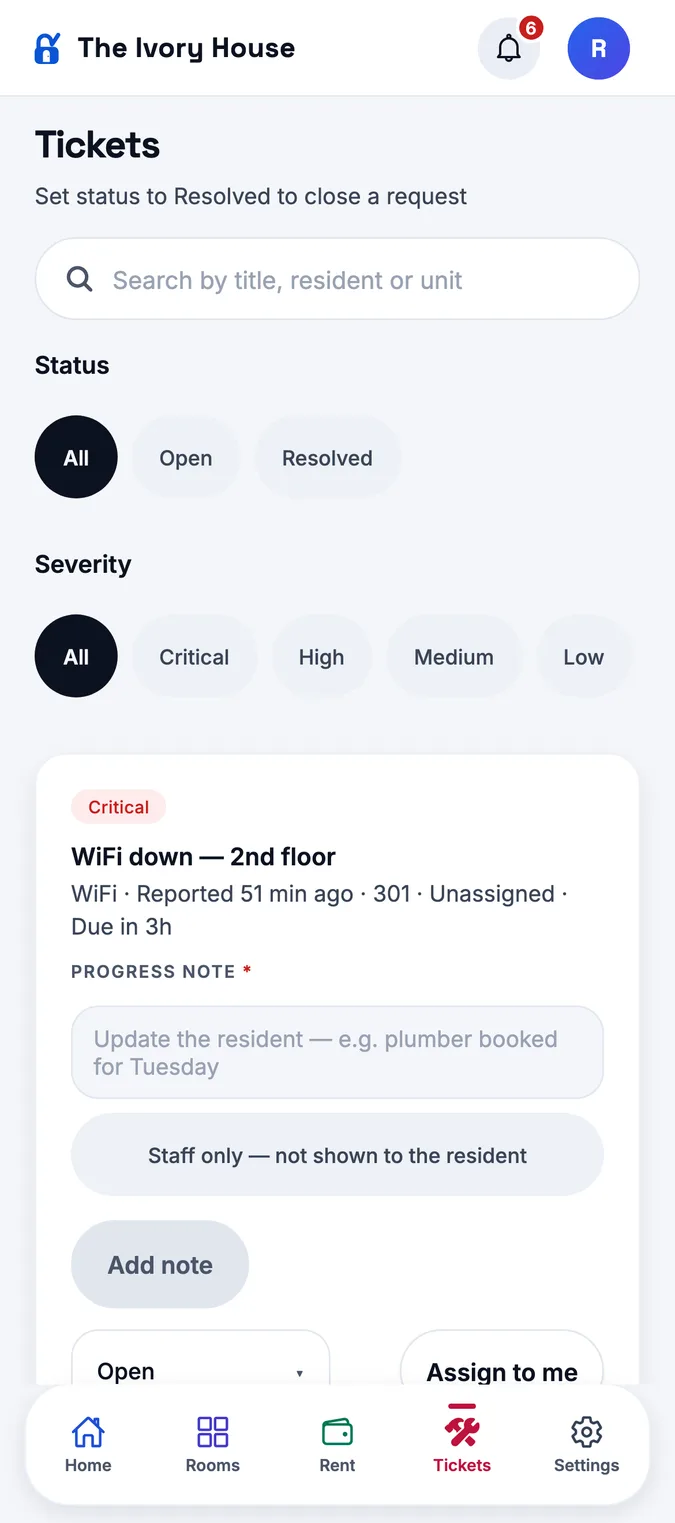
Every complaint carries a severity — Critical, High, Medium or Low — and the urgent ones come first in the list. The manager's home screen shows how many tickets are open and how many of them are urgent, so nothing critical waits behind a paint job.
Make sure the owner can see what is open
An owner does not need to fix every tap. But an owner should be able to answer one question at any time: what is open, and for how long? A complaint that has been open for a week is a sign of something — a vendor who does not turn up, a manager who is stretched, or a building problem that needs money rather than a quick fix.
Look at the open list once a week, not just when a resident calls you directly. If the same complaint keeps coming back from the same room, the repair is not working, and it is cheaper to fix it properly once. If you have staff handling repairs, the same weekly look tells you who is keeping up; our guide to managing PG staff covers the rest of that side of the job.
If you run more than one property, this is where a single view matters. Managers should see their own hostel's complaints; the owner should see all of them, without phoning each manager.
Close the loop with the resident
Most of the goodwill in complaint handling comes from two short messages: "we have seen it, here is what happens next" and "it is fixed — tell us if it is not". Without the second one, a fixed problem still feels unsolved.
- Acknowledge every complaint, ideally the same day, even if the fix will take longer.
- Give a time: "electrician tomorrow between 10 and 12" is better than "soon".
- Tell the resident when it is done, and ask them to check.
- Reopen it if they say it is not fixed, rather than starting a new complaint and losing the history.
Owners and managers track each complaint until it is resolved. When it is marked Resolved, the resident is told, and if the work is not actually done it can be reopened instead of reported all over again.
Warn residents before planned work
A surprise water cut on a weekday morning causes more complaints than any leaking tap. Planned work — tank cleaning, pest control, a power shutdown for wiring, painting a corridor — should never be a surprise.
Post a notice a day or two ahead with the date, the time window and what residents should do: store water, keep rooms unlocked, move things away from a wall. Put it where every resident will see it, not only in a group where it scrolls away in an hour. In StayOne, you post a notice once and every resident sees it.
When it is fair to charge a room for repairs
Most repairs are the owner's cost. Fans wear out, taps leak and walls fade; that is the price of running a PG, and charging residents for it is the quickest way to lose them. But some damage is clearly caused by residents — a door kicked in, a broken window, a cupboard forced open — and it is fair to ask them to pay, as long as your move-in terms said so.
- Agree it before you charge it. Show the damage and the bill, and explain why it is not wear and tear.
- Charge the right people. If one resident caused it, charge that resident. If a shared room's fitting was broken and nobody owns up, splitting it among that room is usually the fairest answer.
- Keep the bill. A photo of the repair receipt settles most arguments before they start.
Unpaid repair charges are also one of the things that can be set against a deposit when someone leaves — see our guide to PG security deposits for how to keep that fair.
Charge room splits a repair bill equally among the residents in a room, or charges each of them a set amount. Each resident sees it in their dues and is notified, and you can cancel the charge until it is paid.
A weekly hostel maintenance checklist
The cheapest complaint is the one you fix before anyone reports it. A thirty-minute walk-round once a week, by the manager or warden, catches most of them. Whether you track it on paper or in StayOne, here is what to look at:
| Area | What to check |
|---|---|
| Bathrooms | Taps, flushes, geysers, drains, exhaust fans, leaks under the basin |
| Rooms | Fans, lights, switches, door locks, window latches, cupboard locks |
| Water | Tank level, motor and pump, any overflow or leak; the date of the last tank cleaning |
| Power | Inverter or generator, the main board, any loose or exposed wiring |
| Internet | Router on each floor, speed in the far rooms |
| Safety | Fire extinguishers in place and in date, exits clear, main-door lock and lights at the entrance |
| Kitchen and dining | Gas line and cylinder, water purifier, cleanliness, pests |
| Common areas | Stairs, corridors, terrace, parking, washing area and dustbins |
Anything you find goes into the same complaint list as everything residents report, with the same urgency scale. Do this every week for a month, and the number of complaints that reach you starts to fall.